The dental slot you think is safest is actually the worst
· Jack Jia · 7 min read
- xona
- dental
- no-shows
- scheduling
- production-data
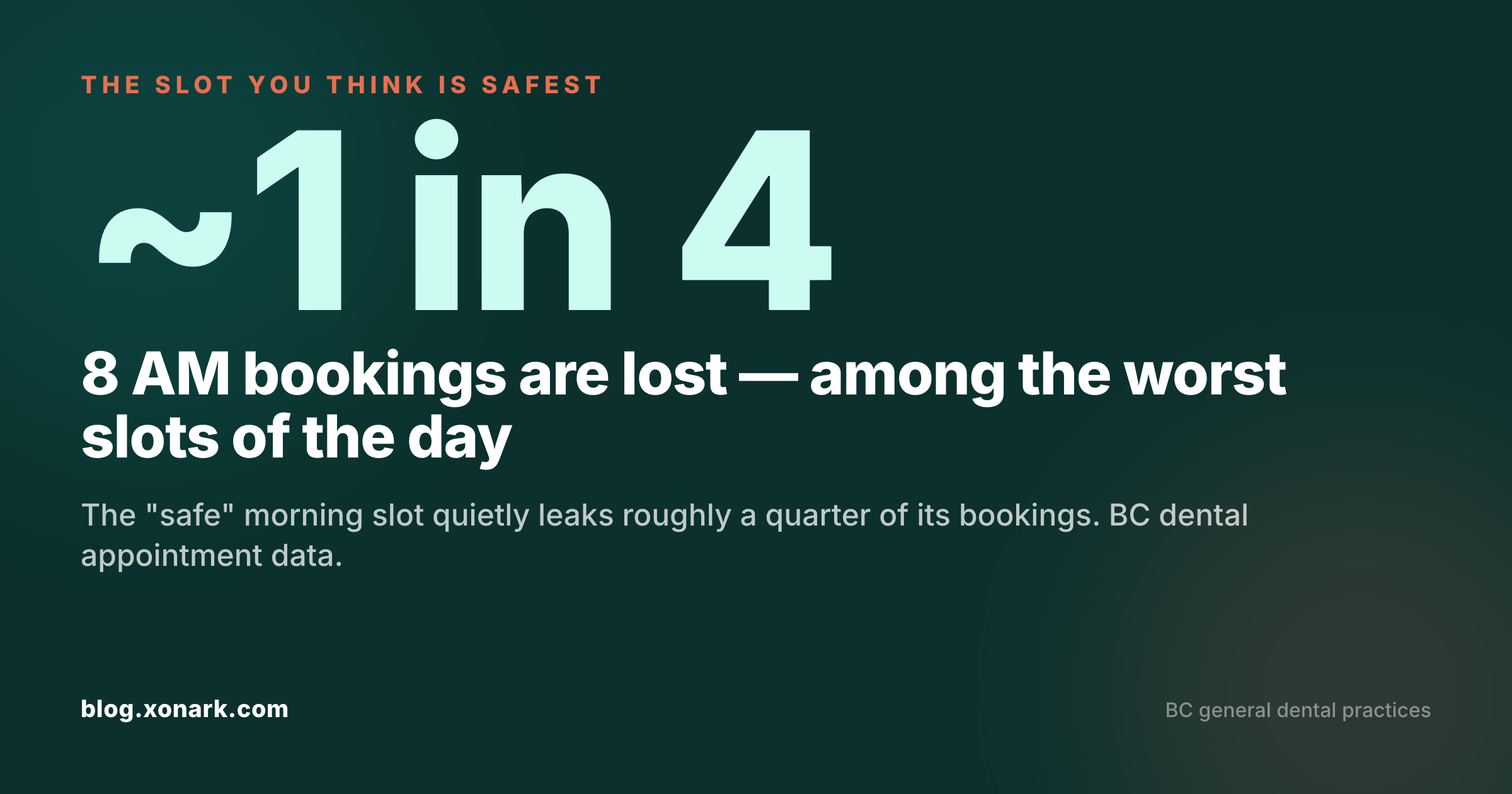
Ask a dentist which time slot in the day is most reliable, and most will tell you: the early morning. The reasoning is intuitive — patients who book 8am have to want it. They have to plan their commute, plan their childcare, sometimes take an early hour off work. Anyone willing to do all that is going to show up.
The data says the opposite.
Source: ~38,000 appointments across anonymized BC general dental practice appointment datasets, January 2024 through May 2026. “Lost” = patient no-show or cancelled. Only appointments with a patient on the books are counted; blocked-off slots without patients are excluded. ±10% windowing where exact numbers would identify a practice.
The shape of the day
Aggregating appointments into 30-minute buckets across the operating day, here’s the lost-rate by slot:
| Slot | Approximate lost rate | Sample size |
|---|---|---|
| 08:00 | ~25% | small |
| 08:30 | ~16% | small |
| 09:00 | ~13% | large |
| 09:30 | ~12% | very large |
| 10:00 | ~11% | very large |
| 10:30 | ~12% | very large |
| 11:00 | ~10% | very large |
| 11:30 | ~11% | very large |
| 12:00 | ~9% | large |
| 12:30 | ~10% | large |
| 13:00 | ~12% | very large |
| 13:30 | ~11% | very large |
| 14:00 | ~11% | very large |
| 14:30 | ~10% | very large |
| 15:00 | ~11% | very large |
| 15:30 | ~9% | very large |
| 16:00 | ~11% | very large |
| 16:30 | ~9% | large |
The 8am slot loses about a quarter of its bookings. The best slot — 3:30pm — loses about one in eleven. The 8am rate is roughly three times the best slot in the day.
This is not a single-practice artifact. The same pattern reproduces in the second practice in the dataset, which has a meaningfully different operating profile and patient mix. Both practices show 8:00 as the worst slot in the day; both show mid-afternoon (15:00–16:30) as the best.
Why the intuition is wrong
The intuition assumes the 8am slot self-selects for committed patients. The data implies the opposite mechanism: the 8am slot is often the only slot a patient was willing to take.
When a practice has no afternoon openings for two weeks, the front desk offers 8am. The patient agrees because the alternative is waiting a month. Two weeks later, when the appointment arrives, the patient — who never preferred 8am — is the most likely to find a reason not to show. Childcare conflict, “I’ll catch the next opening”, running late and just giving up.
The self-selection works in the opposite direction from what the intuition assumed: the 8am slot is filled by people whose actual preferences are not 8am, with a higher likelihood of follow-through failure as a result.
The mid-afternoon slot (15:00–16:30) does well for the inverse reason: it’s almost universally preferred. Patients who book it actually want it. Self-selection helps you here.
What this means for scheduling
Two implications for any practice that runs a tightly-packed schedule:
Don’t treat early-morning slots as the safe ones. If anything, an 8am or 8:30 appointment is the slot most worth confirming the day before with an actual conversation rather than a templated reminder. The cost of letting one of these go silently is the same as letting an afternoon slot go, but the probability is three times higher.
Don’t preferentially offer 8am to new patients. A new patient who has not yet selected into the practice’s culture has no reason to favour an inconvenient slot. Offering 8am as the first available appointment is statistically inviting a no-show. If 8am is the only option, the front desk should be explicit: “Eight in the morning is our earliest. Will that work, or do you want to wait until a 3:30 opens up next week?” — giving the patient a real choice instead of a fake one.
What this means for reminders
A basic reminder track is uniform across slots: every appointment gets the same templated 24-hour-out reminder. Across the slots, that means the same workflow protects a 3:30pm slot with a ~9% loss rate and an 8:00am slot with a ~25% loss rate.
If a practice tiers reminder work by lost-rate risk — the way the previous post in this series argued it should tier by appointment type and lead time — the natural next dimension is slot risk. The intervention for an 8am slot should be heavier than for an afternoon slot:
- Keep the ordinary reminder for everyone.
- For 8:00 and 8:30 slots specifically, add a same-evening confirmation request at about 6pm the night before — replyable, threaded to the front desk inbox, asking the patient to confirm they are coming. Silence by closing time or early morning should flag the appointment for a front-desk call, when there is still a chance to pull the patient in or release the slot.
- For reliable afternoon slots, avoid extra noise unless the patient history says otherwise.
The data is clear about where a stronger reminder workflow should focus: heavier confirmation for the riskiest inventory, not more noise for the whole schedule.
Caveats worth flagging
The 8:00 cell is the smallest cell in the table. Across the dataset, the 8:00am slot has a few hundred appointments — well below the sample size at every other slot. The 25% lost rate is real and reproduces across both practices in the dataset, but you would not bet a clinical decision on the 8am cell alone. You would bet on the pattern across slots, which is what the table above shows.
Two confounders we have not yet ruled out:
- Appointment-type mix. If 8am is disproportionately recall appointments (which have a higher base rate — see the previous post), some of the 8am penalty is the recall penalty in disguise. We have not yet stratified the analysis by appointment type.
- Day-of-week interaction. Monday 8am may behave differently from Friday 8am. We have looked at weekday × weather and found no major interactions, but we have not yet looked at weekday × slot specifically.
Both are addressable from the same dataset and will appear in follow-up writing. The headline — 8am is structurally worse than the rest of the day — stands.
The honest sentence
Most dental practices treat the early-morning slot as their reliable inventory. The data says it’s their worst inventory. Whatever you’re doing to confirm and protect your 3:30pm bookings, you need to do double for your 8am bookings.
The reverse mistake — overweighting reminders on afternoon slots that don’t need them while underweighting the morning ones that do — is one of the small but consistent ways practices leave production on the table.
The next post in this series zooms out from slots to patients: a small minority of patients accounts for nearly 40% of all lost appointments — and that concentration changes where reminder and front-desk effort should go.