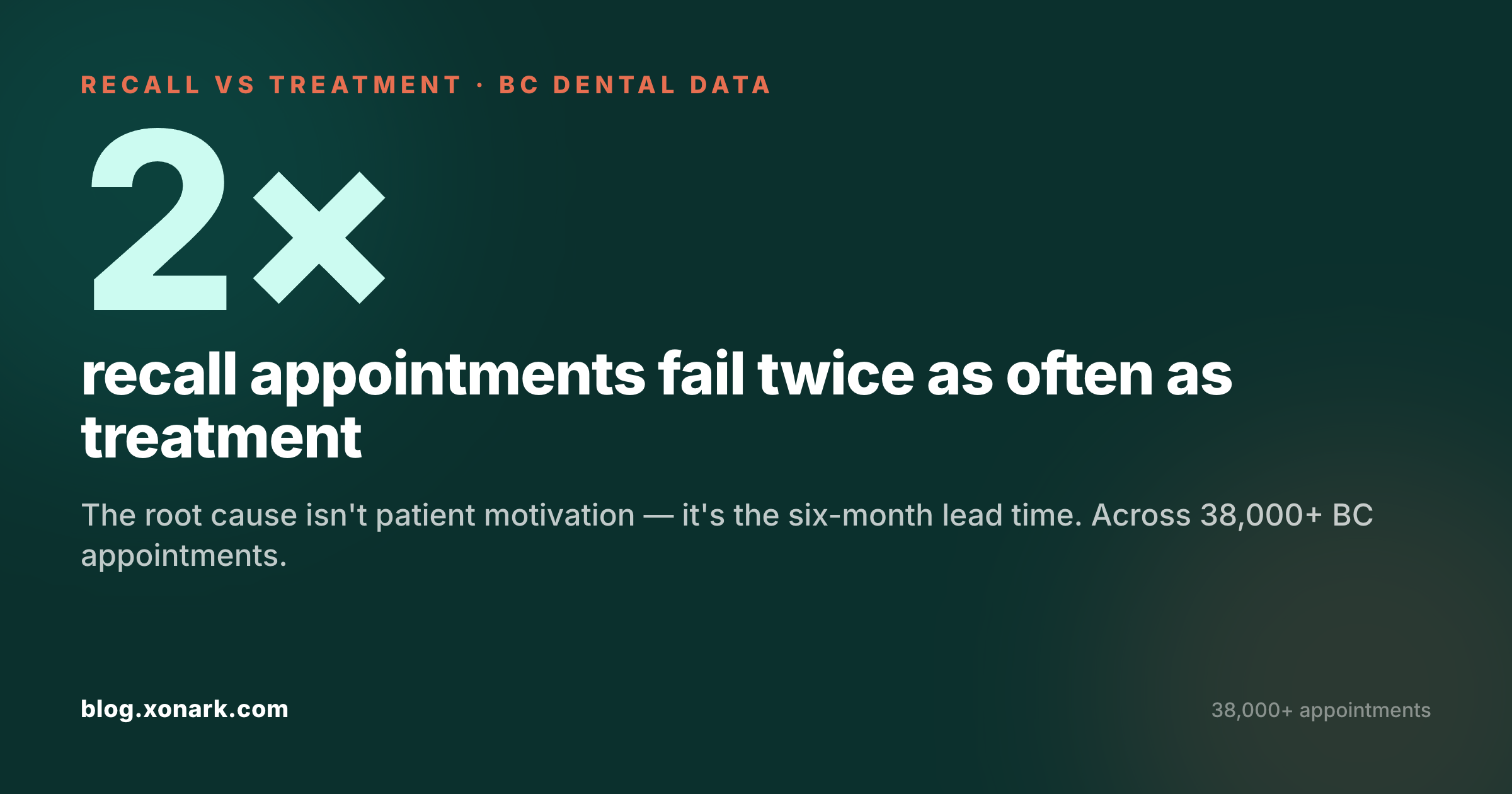
Recall appointments fail twice as often as treatment. The six-month gap explains it.
· Jack Jia · 6 min read
- xona
- dental
- recall
- no-shows
- production-data
A recall appointment — the routine 6-month hygiene visit — is booked six months in advance. A filling appointment is booked one to three weeks in advance. An emergency appointment is booked the same day, sometimes the same hour.
If you sort appointments by how much time elapsed between booking and the appointment itself, you get a rough proxy for how plausible it was that the patient’s life still resembles the life they had when they booked. And when you look at how often each type of appointment ends up lost — patient didn’t show, or cancelled — the order falls in line with that proxy.
Source: ~38,000 appointments across anonymized BC general dental practice appointment datasets, January 2024 through May 2026. “Lost” = patient no-show or cancelled. Appointment-type names normalized; “Recall” combines 3-/4-/4.5-/6-month recall and hygiene categories. ±10% windowing where exact numbers would identify a practice.
The base rates
Aggregating across the dataset, by appointment type:
| Appointment type | Approximate lost rate |
|---|---|
| Emergency | ~4% |
| Ortho | ~5% |
| New-patient exam | ~7% |
| Specialty exam | ~8% |
| Filling / restorative treatment | ~9% |
| Recall (hygiene) | ~16% |
Recall is almost 2× the loss rate of treatment and 4× the rate of emergency. This pattern reproduces across the practices in the dataset; it isn’t a single-practice quirk.
The natural reaction is to interpret this morally: “patients don’t value preventive care.” That framing is doing nothing for the practice and isn’t supported by the data. The simpler explanation is structural.
Lead time is the actual variable
An emergency appointment is, by definition, booked because the patient is in active pain or distress right now. By the time the appointment happens — same day, next day — nothing in the patient’s life has changed enough to invalidate the booking. Loss rate is correspondingly tiny.
A filling appointment is booked one to three weeks out, usually because a recent exam flagged something. The patient remembers why they made the appointment; their treatment plan is fresh. Some life events do intervene in three weeks, but not many. Loss rate is moderate.
A recall appointment is booked six months ahead, typically right at the end of the previous hygiene appointment (“we’ll see you in May”). Across six months, life happens: job changes, moves, new childcare schedules, plain forgetting. A ~16% loss rate isn’t a character flaw — it’s what a six-month gap does to anyone’s calendar.
The lesson is not “recall patients are flaky.” It is “the recall-booking workflow is structurally fragile, and the fragility is in the booking model, not in the patient.”
What this means for reminders
Most basic reminder systems fire one message roughly 24 hours before the appointment. For a 6-month-out recall, that means six months of silence followed by a single nudge the day before. The 16% loss rate is the result.
The shape of intervention that the data suggests:
- For emergencies and same-week treatment: the existing single-send reminder is well-matched to the loss risk. Don’t change it.
- For 1–3 week-out treatment: the single send is fine, with an optional confirmation request on top.
- For 6-month recalls: the single send 24 hours out is not the intervention. The intervention is a re-engagement touch 2–4 weeks before the appointment — “Do you still want this slot?” — giving the patient a clean path to confirm, reschedule, or release it weeks in advance, before it costs the practice anything.
The 2–4 week touch is not a “reminder” in the traditional sense. It is a recall on the recall. The economic argument is straightforward: a slot released three weeks in advance can be filled with another patient. A slot released 24 hours in advance via a same-day cancel can usually only be filled by someone in a tight network. A slot lost to a no-show is gone entirely. The earlier the practice has the information, the more value it can recover.
A note on what “recall” means in this dataset
A few terminology notes for readers who run dental practices:
- The “Recall” bucket above includes both
RecallandHygieneappointment-type variants (3-month, 4-month, 4.5-month, 6-month). The loss rates within those sub-buckets are similar; we report the combined number. - Loss rate here is lost as a share of appointments scheduled with a patient on the books. Time slots that were blocked off but never had a patient assigned are excluded.
- Same-day cancellations are folded into the “cancel” portion of the loss count because they are economically equivalent to no-shows for the practice (slot value destroyed, no time to refill).
The structural shift
The cleanest sentence from this analysis:
Recall is failing because the practice trusts a single 24-hour reminder to bridge a six-month gap between booking and appointment. That trust is not warranted by the data.
The right move is not to add more nudges in the last 48 hours. It is to add a structured re-engagement window weeks ahead of the appointment — when the patient still has the agency to clean up the booking proactively, and the practice still has the time to fill the slot if it comes free.
The product lesson for Xona is clear: do not treat recall like an ordinary tomorrow reminder. The defensible workflow is a multi-week-out confirmation/re-engagement track that gives the patient an easy way to confirm, reschedule, or release the slot while the practice can still refill it.
The next post in this series goes after a counterintuitive scheduling pattern: the time of day that practices tend to call their “easiest slot” is actually the worst slot in the schedule for keeping appointments.