Most online booking paths in Canadian dentistry still ask the front desk to call back
· Jack Jia · 3 min read (updated August 9, 2026)
- dental
- data
- schedule-leakage
- canada
- patient-experience
Validated update — August 9, 2026. This article now uses the six mutually exclusive booking statuses in the release-ready Canadian dental findability scorecard, generated with the subject-anchored parser committed at
97d5b2c8c8d8358422c52b005c36df3373d4e525. The earlier booking denominator is retired.
“Book online” can describe two very different outcomes. One path lets a person choose an open slot and confirm it. The other collects preferred times and asks the front desk to make contact later.
We classified the destination reached from 18,910 checked Google profiles rather than stopping at whether a link existed.
The six checked outcomes
| Booking status | Checked profiles | Share of 18,910 |
|---|---|---|
| Real-time self-scheduling | 1,330 | 7.0% |
| Appointment request | 3,045 | 16.1% |
| Weak homepage | 253 | 1.3% |
| Dead destination | 139 | 0.7% |
| Blocked check | 1 | less than 0.1% |
| No Google-profile booking link | 14,142 | 74.8% |
The six counts sum exactly to all 18,910 checked profiles.
A working online path is usually a request
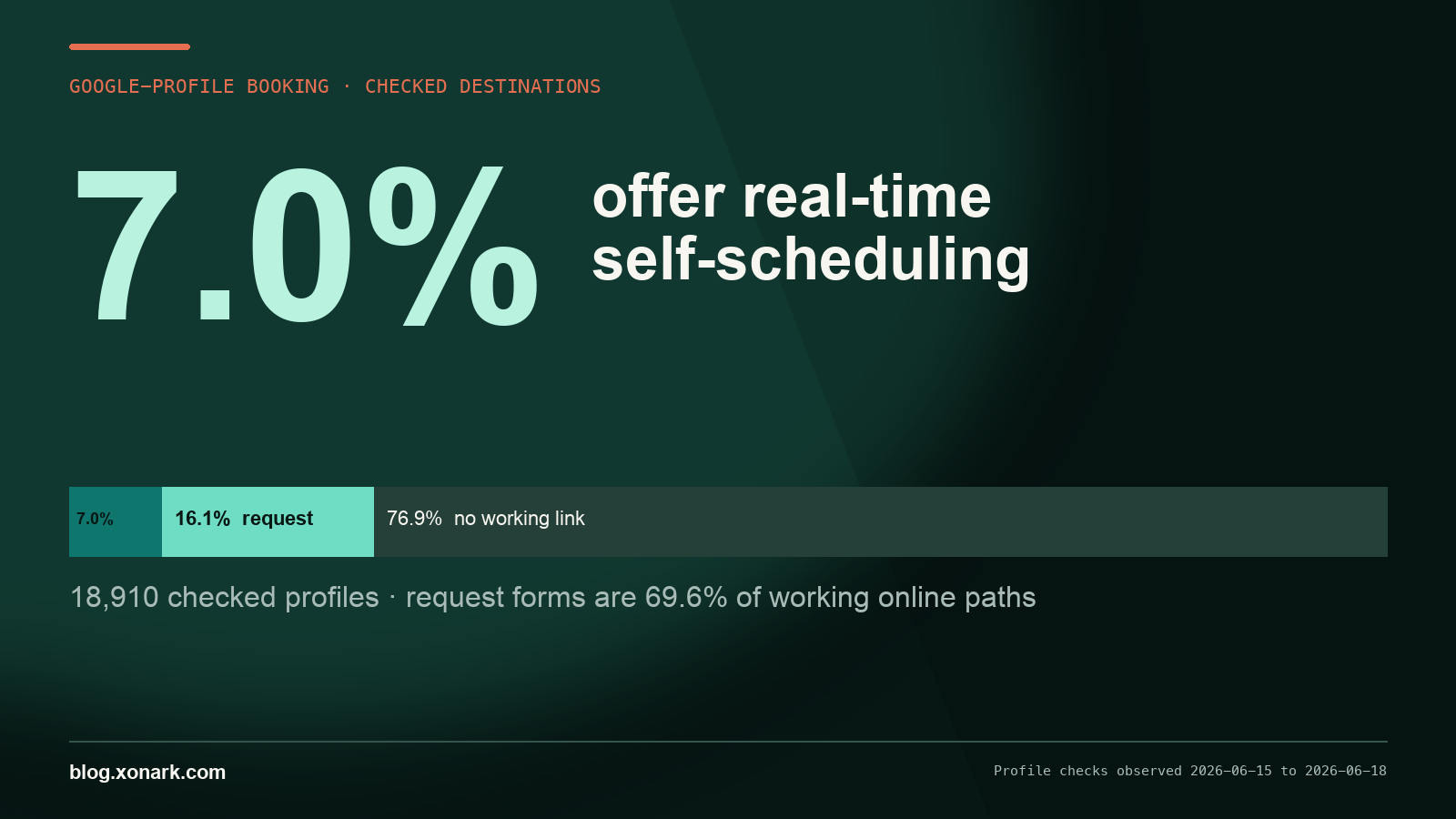
Real-time scheduling plus appointment requests gives 4,375 working online paths, or 23.1% of checked profiles. Within those working paths:
- 3,045 of 4,375 (69.6%) were appointment requests; and
- 1,330 of 4,375 (30.4%) were real-time self-scheduling.
So roughly seven in ten working online paths still pass the final scheduling decision back to staff.
That does not make a request form useless. It can capture intent cleanly and give the front desk context. It simply does not confirm a time by itself, so it should not be reported as if it does.
What “no working link” means here
The visual groups no link, weak homepage, dead destination, and the one blocked check as 14,535 of 18,910 (76.9%) without a confirmed working online path in this check. The article keeps those categories separate because their fixes are different:
- a missing link needs a listing action;
- a weak homepage needs a clearer destination;
- a dead link needs repair or removal; and
- a blocked check needs a later verification rather than a guess.
The useful five-minute test
Open the Google profile on a phone and tap the booking action yourself. Check whether the destination:
- shows real appointment availability;
- confirms a selected time;
- only asks for preferred times;
- lands on a generic homepage; or
- fails.
That test answers a narrower, more useful question than “do we have online booking?” It shows what a person can actually finish from the listing today.
Boundaries
- The status is the canonical profile recount result for rows with
profile_checked_at. Checks were observed from June 15 to June 18, 2026. - “Real-time” means live self-scheduling. “Request” means a form or callback that still needs confirmation.
- The measure begins at the Google profile. A clinic may expose a different path elsewhere on its own website.
- The data does not record whether a person clicked, called, abandoned, or completed an appointment.
- These are aggregate observations; no practice is named.
The canonical scorecard carries every count, denominator, method, source field, and observation window. To test one practice’s path, run the free Dental Practice Health Snapshot.
Validated release receipt
Source snapshot SHA-256: d20c1fe2cd6c6245c3077eba6d9be224715c1711908fad5850b61b81fe97e0aa. Parser SHA-256: 1ce38df0c5b129cbb20591c1d5f846f8a4b6e3592d36ca7149bef70486a38123. Aggregate generator SHA-256: 3e614ef6c4d6c0fe11ac5e5728dd961263ab6d161a2e841cae12e13839a30683.