Your reviews are excellent. Your Google profile still may not open the booking door.
· Jack Jia · 3 min read (updated August 9, 2026)
- dental
- data
- schedule-leakage
- canada
- revenue-leakage
Validated update — August 9, 2026. This article now uses the rating and booking-status cross-tab in the release-ready Canadian dental findability scorecard, generated with the subject-anchored parser committed at
97d5b2c8c8d8358422c52b005c36df3373d4e525. The earlier rating universe and cross-tab are retired.
The usual advice to a dental practice worried about growth is “get more reviews.” The data suggests many Canadian listings have already cleared that reputation threshold. The public path after the review is where a separate gap appears.
Two denominator-labelled observations from the validated cohort:
- 14,681 of 18,535 listings with a positive stored rating (79.2%) were rated 4.5 or higher.
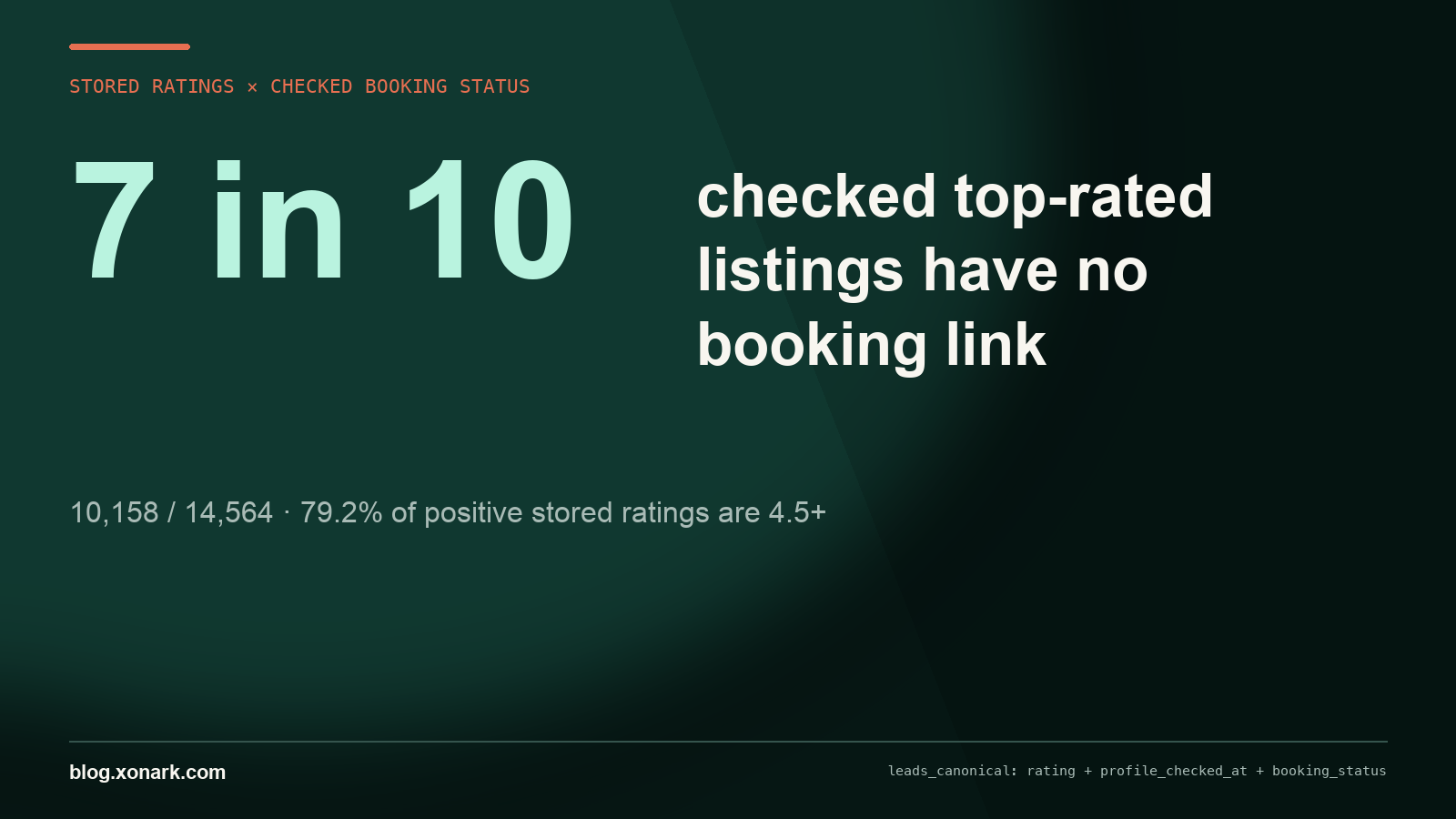
- 10,158 of 14,564 checked listings rated 4.5 or higher (69.7%) had no booking link on the Google profile.
Those are not the same denominator. The first describes the stored-rating distribution. The second intersects a top rating with a completed profile check and exactly booking_status='none'.
Reputation can earn attention without completing the path
A rating may help a listing earn a click. It does not create the booking action that appears after the click. In this sweep, roughly seven in ten checked top-rated listings lacked that Google-profile booking link.
That does not prove a patient abandoned the clinic. A practice may still accept appointments on its own website or by phone. It does show that reputation and profile bookability are separate public-front-door fields, and one cannot stand in for the other.
Strong reviews raise the value of checking the next step
When a clinic has built a strong rating, it is worth testing the path immediately beside it:
- Open the full Google profile, not only the compact search card.
- Look for the booking action.
- Follow the destination on a phone.
- Confirm whether it provides real-time scheduling, an appointment request, a weak homepage, or a dead end.
- Repeat the check after changing a vendor, domain, or scheduling flow.
The validated cohort found only 1,330 of 18,910 checked profiles (7.0%) with real-time self-scheduling and 3,045 (16.1%) with an appointment request. That is why a visible button still needs a destination check.
What the cross-tab does and does not say
- “Positive stored rating” means a rating greater than zero on the canonical listing row. Its observation window ran from April 14 to June 9, 2026.
- “Rated 4.5+ with no Google-profile booking link” uses only top-rated rows with a completed profile check. Booking checks ran from June 15 to June 18.
- The cross-tab uses the stored rating and canonical booking status. The validation receipt separately compares stored ratings with subject-anchored raw ratings and keeps the disagreement rate below its gate.
- The data does not measure which listing a patient selected, whether a patient called, or whether an appointment was completed.
- No practice is named and no per-practice revenue value is inferred.
Reputation and findability work together, but they are not substitutes. The practical fix is to protect the path a strong reputation earns: keep the listing accurate, make the booking destination work, and give people a clear fallback when they still call.
The full scorecard publishes the method, rating cross-tab, observation windows, validation receipt, and downloadable files. To check one practice rather than the aggregate, run the free Dental Practice Health Snapshot.
Validated release receipt
Source snapshot SHA-256: d20c1fe2cd6c6245c3077eba6d9be224715c1711908fad5850b61b81fe97e0aa. Parser SHA-256: 1ce38df0c5b129cbb20591c1d5f846f8a4b6e3592d36ca7149bef70486a38123. Aggregate generator SHA-256: 3e614ef6c4d6c0fe11ac5e5728dd961263ab6d161a2e841cae12e13839a30683.