We checked 19,065 Canadian dental listings. Three in four lack a Google booking link.
· Jack Jia · 4 min read (updated August 9, 2026)
- dental
- data
- schedule-leakage
- canada
- findability
Validated update — August 9, 2026. This article now uses the release-ready Canadian dental findability scorecard, generated from a coherent read-only database snapshot with the subject-anchored parser committed at
97d5b2c8c8d8358422c52b005c36df3373d4e525. The earlier June aggregate is retired.
The usual story about dental schedule leakage starts at the phone: missed calls, after-hours voicemail, overflow. But there is a step before the phone rings. Can someone who finds a clinic on Google see a path to book or contact it?
We measured that public front door. The validated cohort contains 19,065 deduplicated dental listings from a Canada-wide Google Maps sweep. It includes exact patient-care dental business types and excludes narrow institutional and service categories. It is a defined observed cohort, not a census of every dentist in Canada.
Three different denominators
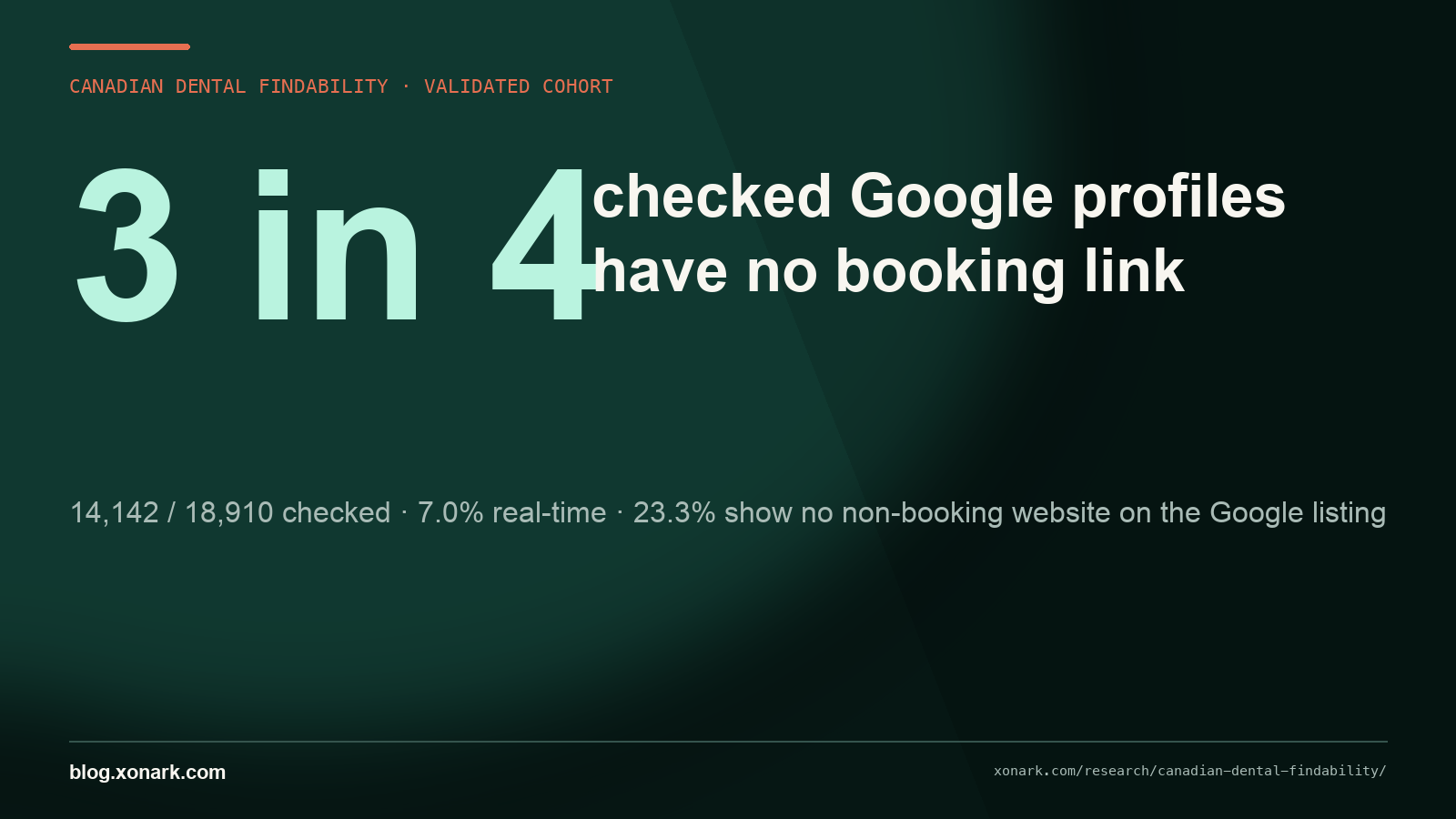
- 74.8% had no booking link on the Google profile: 14,142 of 18,910 checked profiles. Profile checks covered 99.2% of the cohort and were observed from June 15 to June 18, 2026.
- 23.3% had no non-booking website on the listing: 4,444 of all 19,065 deduplicated listings. That is a listing-field measure, not a statement about whether the business exists elsewhere online.
- 15.3% had no crawler-detected capture path after a successful website fetch: 1,756 of 11,455 successful fetches. The crawler looked for a contact form or a booking/request link. Other contact channels were not measured.
Those figures describe different surfaces. Combining their numerators or treating them as one funnel would be misleading.
A booking link is not always a completed booking
Among the 18,910 checked Google profiles:
- 1,330 (7.0%) led to real-time self-scheduling;
- 3,045 (16.1%) led to an appointment request;
- 253 (1.3%) degraded to a weak homepage;
- 139 (0.7%) were dead;
- 1 check was blocked; and
- 14,142 (74.8%) had no Google-profile booking link.
Real-time scheduling plus appointment requests gives 4,375 of 18,910 (23.1%) checked profiles with a working online path from the listing. The request path still needs a person to confirm a time; the real-time path does not.
What the measures mean
- No Google-profile booking link means
booking_status='none'after opening and checking the profile. It does not mean the practice cannot take appointments elsewhere on its website or by phone. - No listing website means no non-booking website was stored on the Google listing after known booking-only hosts were excluded.
- No detected capture path means the website crawler successfully fetched the site but found neither a contact-form URL nor a booking/request-link URL. It does not rule out a phone number, email address, chat widget, or path the crawler could not detect.
- These are aggregate observations. No practice is named and no per-practice patient or revenue outcome is inferred.
What the observation windows are
The listing cohort, stored ratings, and listing-website fields were observed from April 14 to June 9, 2026. Google-profile booking checks ran from June 15 to June 18. Website-capture observations ran from April 15 to June 9. Raw listing province was parsed from records observed from June 29 to July 3.
That is why the report carries a window on every metric rather than presenting the release date as if the whole market were scanned that day.
Why this is an upstream leak
A strong front desk cannot respond to demand it never sees. A missing or degraded public path can stop the journey before a call, form, or booking request reaches the clinic. The useful response is not to assume what the patient did next; it is to check the actual listing and destination, then repair the path that is missing.
The State of Canadian Dental Findability 2026 publishes the metric objects, all thirteen jurisdiction rows, limitations, JSON, CSV, fact sheet, and charts. To inspect one practice rather than a national aggregate, run the free Dental Practice Health Snapshot.
Validated release receipt
Source snapshot SHA-256: d20c1fe2cd6c6245c3077eba6d9be224715c1711908fad5850b61b81fe97e0aa. Parser SHA-256: 1ce38df0c5b129cbb20591c1d5f846f8a4b6e3592d36ca7149bef70486a38123. Aggregate generator SHA-256: 3e614ef6c4d6c0fe11ac5e5728dd961263ab6d161a2e841cae12e13839a30683. The canonical report is the source of record.